Galter in Bloom
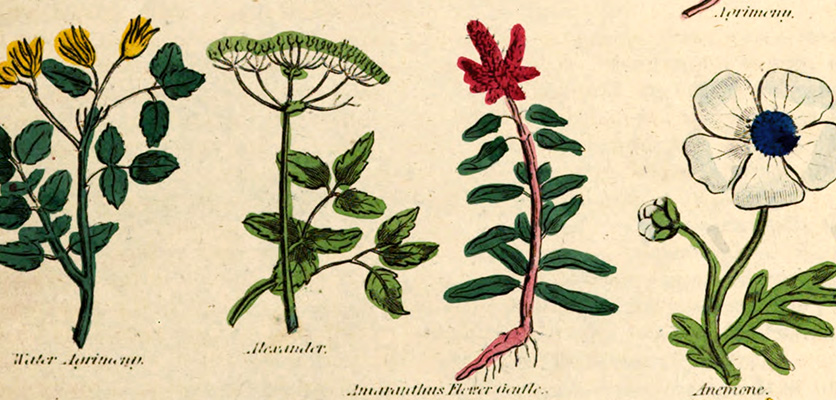
500 Years of Botanical Illustration
Location: Eckenhoff Reading Room
Date: Oct. 7, 2025 to Feb. 5, 2026
Contact: ghsl-specialcollections@northwestern.edu
This exhibit showcases selections from Galter Library’s collection of illustrated botanical books. Medical libraries typically collected herbals—books that systematically describe the appearance, properties and uses of plants—because physicians would have consulted them for herbal remedies.
But physicians’ interests extended beyond the curative qualities of plants, and many collected non-medicinal botanical books for their stunning illustrations. Eclipsing the collectors were those who were also naturalists, studying and writing about the natural world in addition to their medical work.
Color
Color plays many roles in botanical illustration. It can add information to help identify plants and distinguish them from each other, aiding in botanical study and medicinal use by a layperson. It can increase the readability of a complex, highly detailed image, allowing the viewer to better understand what they are seeing. It can also be purely aesthetic, adding to the beauty of an illustration.
Color in printed illustrations comes in two basic varieties—hand-coloring and mechanically printed color, sometimes in combination with each other. Before the 19th century, when innovations in printing technology made color printing feasible on a large scale, most coloring was done by hand, whether by a skilled artist under the direction of the author, which was expensive, or by the owner of the book for their own use. Color printing made book production cheaper, thus allowing more people to own colorfully illustrated books.
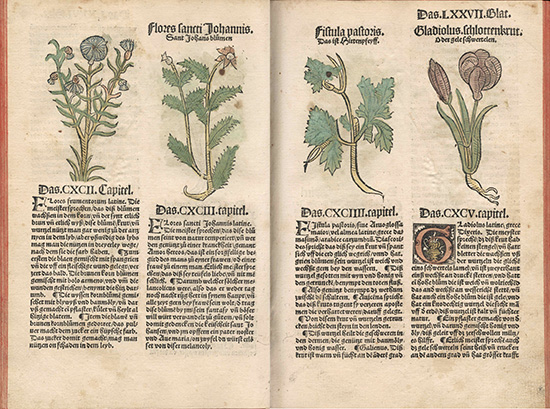
Flores frumentorum (Cornflower)
Flores sancti Johannis (St. John's wort)
Fistula pastoris (Shepherd's pipe, common water plantain)
Gladiolus Schlottenkrut (German bearded iris)
Hortus Sanitatis, Germanice: Gart der Gesundheit. Strasbourg: Reinhard Beck, 1515.
Author and artists unknown.
Hortus Sanitatis (Garden of health) is an early Renaissance encyclopedia of natural history, with entries on the medicinal uses of plants, animal products, and other substances found in nature. The woodcut illustrations are highly stylized, with the parts of the plant laid out in a way that makes them easy to identify, rather than depicting them as they would truly appear in nature. Like almost all printed European books of its era, the illustrations in this book are colored by hand with typically chalky and opaque pigments, which can sometimes obscure the details of the woodcut. The colorist here uses multiple colors to give a more accurate representation of the plants depicted.
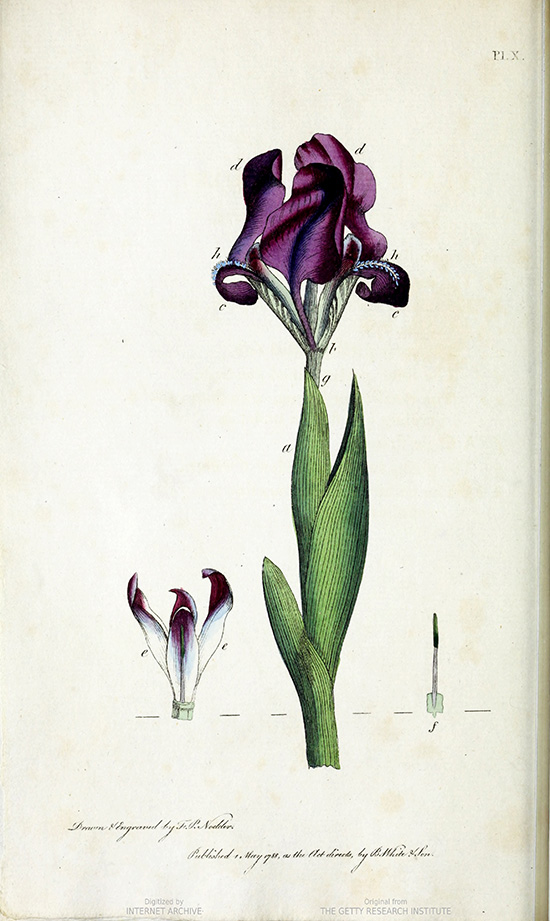 Iris pumila (Dwarf iris)
Thirty-eight Plates, with Explanations; Intended to Illustrate Linnaeus's System of Vegetables. London: B and J. White, 1794.
Thomas Martyn (1735-1825), author.
Frederick Polydore Nodder (fl. 1770-1801), artist and engraver.
In the 1730s, Swedish botanist Carl Linnaeus developed a "sexual system" of grouping and identifying plants, based on the number and arrangement of a plant's male and female organs (stamens and pistils). Thus, this book features each plant's stamens and pistils in order to demonstrate Linnaeus's new system. As with most scientific botanical texts, color—with its many variations—is not an important part of the classification or description of the plant, but that didn't mean the illustrations couldn't be beautifully colored for aesthetic reasons. The use of watercolors allows for more delicate colors that do not obscure the details of the illustration, and, with only 38 plates, the colorist could spend time adding vibrant colors to each engraving.
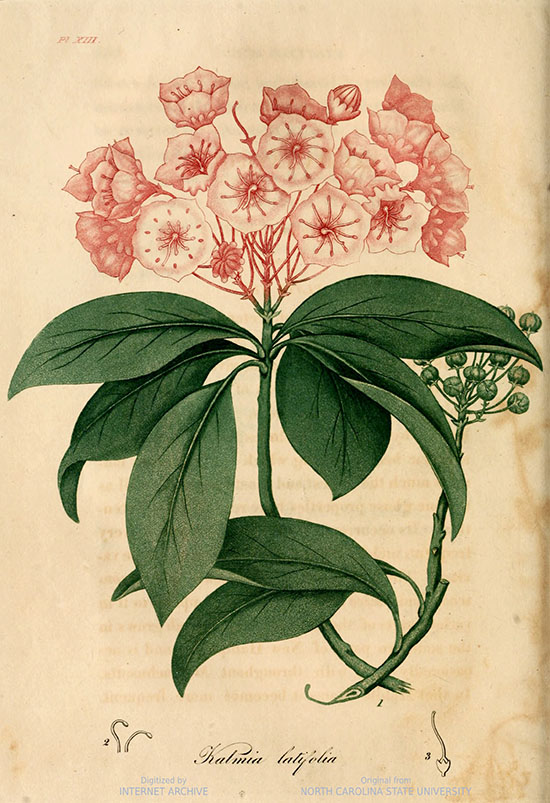 Kalmia latifolia (Mountain laurel)
American Medical Botany. Boston: Cummings and Hilliard, 1817-21.
Jacob Bigelow (1787-1879), author and artist.
William B. Annin (1791?-1839) and George Girdler Smith (1795-1878), engravers.
Jacob Bigelow stands out in history both as a botanist and as a pioneer in printing. Rather than paying an artist to hand color prints of his botanical drawings, he developed a new method for printing multicolor images, decades before the invention of chromolithography (for more on this process, see Johnson's Medical Botany of North America at left). Bigelow based his method on the aquatint process, which creates a unique tonal texture in areas of solid color (seen in the leaves in the above illustration), and which was unusual for botanical illustration. The different areas of color were created through the à la poupée technique, in which multiple inks are applied onto a single plate with wads of cloth called dolls (poupée in French), allowing all the colors to be printed at once. Bigelow's new process made American Medical Botany the only book with full-color printed illustrations published in the United States in the early 19th century.
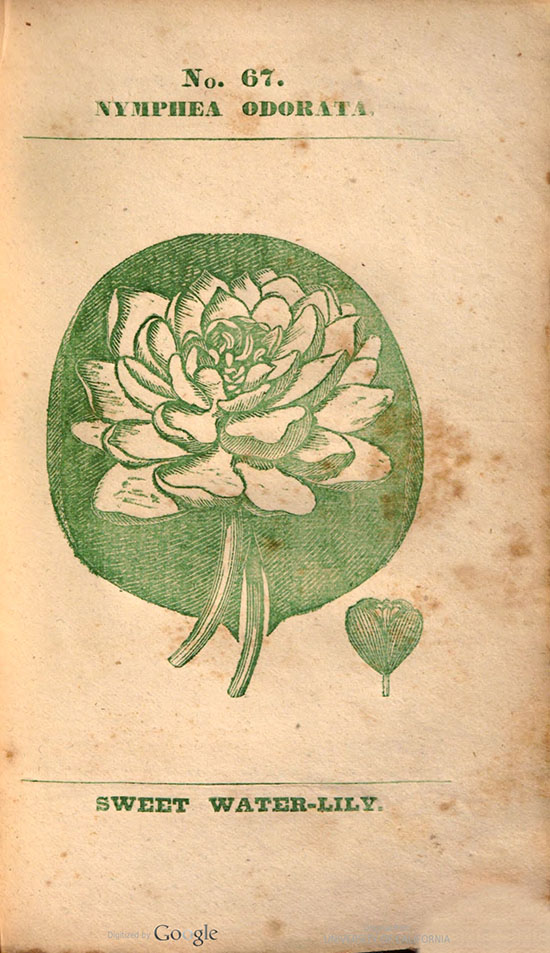 Nymphea odorata (American white waterlily, fragrant waterlily)
Medical Flora. Philadelphia: Atkinson & Alexander, v. 2, 1830.
C.S. Rafinesque (1783-1840), author.
While color printing was possible by the 1820s, it was still expensive, as was paying for hand-coloring. Instead, Rafinesque made the unusual decision to print the illustrations in his Medical Flora—including the accompanying text—in green ink, giving them some semblance of naturalism while keeping costs down, and creating a unique botanical book in the process. The illustrations are wood engravings, created with a technique developed in the late 18th century that allowed for highly detailed images on a small scale (see Thornton's New Family Herbal in the "Home Health" case for more wood engravings by Thomas Bewick, the inventor of the medium). This allowed for the unusual "white line" style, in which details are created with negative space in a dark area of the image.
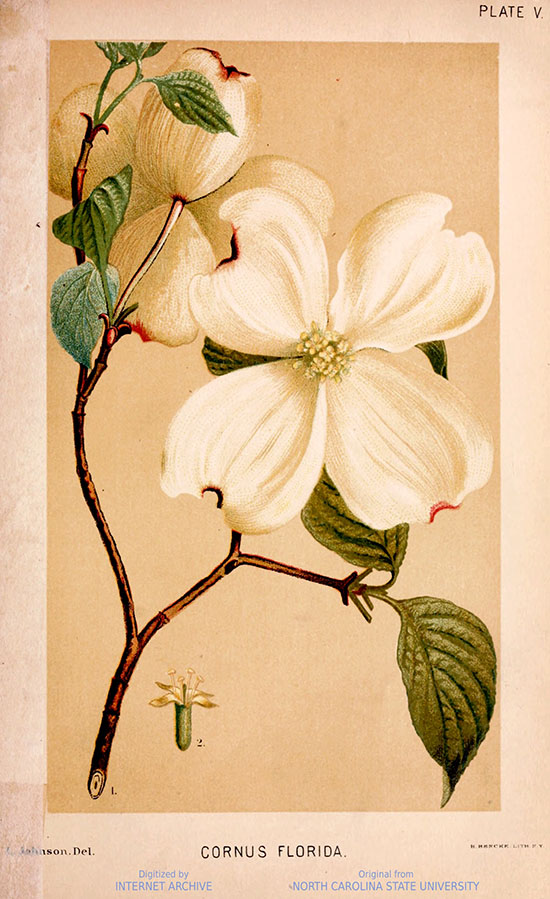 Cornus florida (Flowering dogwood)
A Manual of the Medical Botany of North America. New York: W. Wood & Co., 1884.
Laurence Johnson, author and engraver.
H. Bencke, lithographer.
The lithographic printing process, using etched blocks of stone to print an image, was developed and perfected in the 19th century. The durable stone allowed the image to be printed many times while causing little deterioration, revolutionizing the mass production of illustrated books.
Chromolithography—the use of multiple stones to print multiple colors—became the most popular method of color printing in the 19th century, used for everything from mass-produced advertising to fine art reproductions. Each massive stone had to be placed just right to ensure the colors lined up in the finished image. This laborious process made chromolithography time consuming, so using fewer colors and details would make books with larger print runs, like this one, easier to produce.
All Shapes & Sizes
Hortus Eystettensis (The garden of Eichstätt) is one of the largest botanical works ever published, at a mammoth 18 by 23 inches and illustrated with 374 engravings depicting 1000+ flowers. This book was the ultimate extravagance of its day due to its massive size and its scarcity: only 300 copies were printed. The black and white versions were intended for the professional class, while the luxurious hand-colored copies sold for 10 times the price to Europe’s aristocracy. This was not a book to take out into the field for plant identification; the illustrations were meant for enjoyment. Rather, it was a signifier of the owner’s wealth. It also served to spur others to collect exotic flowers, to inspire extravagant gardens, and to provide patterns for embroidery, a common hobby for aristocratic women.
On the other hand, Histoire des plantes (Chronicle of European plants) is a compendium of novel and traditional botanical knowledge. It is based on the work of Italian physician Pietro Mattioli, one of the most influential naturalists in Europe, who published important commentaries on ancient botanical texts and described new plant species.
The publisher paired this respected source material with the work of Gaspard Bauhin, a Swiss botanist and anatomist who sought to categorize plants according to a new classification structure—one similar to the Linnaean system that botanists still use today.
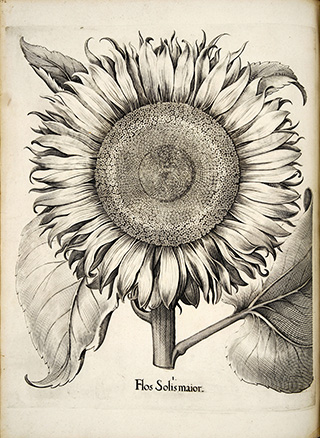
Helianthus annuus (Sunflower)
Hortus Eystettensis, vol. 2. Nuremberg: 1613.
Basilius Besler (1561-1629), creator.
Sebastian Schedel (1570-1628), illustrator.
Wolfgang Kilian (1581-1662), engraver.
This book is one of the first florilegia, or, books featuring a collection of flowers, usually those grown in a specific area like a botanic garden. Florilegia differ from herbals: the artistry of the illustrations is more important than conveying medicinal or scientific knowledge.
Hortus Eystettensis was created to chronicle and celebrate the prince of Eichstätt’s remarkable garden, and the focus of the book is the illustrations. The artists used copperplate engraving to achieve organic, graceful lines and to create much finer detail and shading than was possible with woodblock illustrations, and, as a result, the images are extraordinarily eye-catching and beautiful.
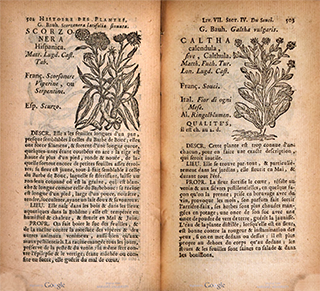
Scorzonera latifolia sinuata (Black salsify, viper's grass)
Caltha vulgaris Calendula (common marigold)
Histoire des plantes de l'Europe, vol. 2. Lyon, France: Jean-Bapt. De Ville, 1680.
Pietro Mattioli (1501-c. 1578), author.
Gaspard Bauhin (1560-1624), author.
When compared to the Hortus Eystettensis, this book may seem insubstantial. But its size and layout indicate that it was designed for identifying plants, whether at home or farther afield. Each entry is formatted to fit on one page and includes the same information across entries. This uniformity makes it easier for the reader to scan the page for the desired information. The woodcuts—though small—include enough detail for plant identification. More page space is given to the text because the knowledge therein is considered more important than an ornate illustration.
Home Health
An important source of botanical illustrations in a medical library is books on materia medica (literally, medical material), or pharmacology. Until the 19th century, when synthetic drugs were first created, all medicines came from the natural world, particularly plants. Materia medica texts could be academic, describing the plants scientifically, but some were intended for home use by laypeople. At a time when families—especially in rural areas—might not have easy access to a doctor, and before the mass manufacture of pharmaceuticals of any kind, households would create their own remedies from the plants they could find in the surrounding area. Having guides like the books in this case aided in the identification of plants and provided instructions on how to prepare herbal remedies. The illustrations are often more diagrammatic than naturalistic, ensuring the reader can see all the important identifying parts of the plant. In some cases, the illustrations may have been more decorative than functional, only there to give a quick idea of the plant for someone who did not or could not read the full description.
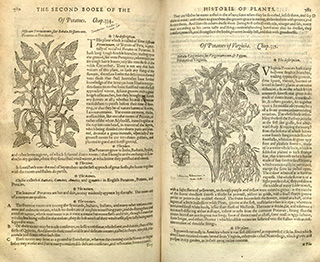
Batata hispanorum (Spanish Sweet potato)
Batata virginiana (Virginian Potato)
The Herball; or, Generall Historie of Plantes. London: John Norton, 1597.
John Gerard (1545–1612), author.
Early books on materia medica were typically called "herbals," referencing the herbs and other plants described within. These books focused on individual plants and their traditional uses. By the 17th century, the development of chemistry and pharmacology meant that more complicated medicines could be created by combining plants and other substances, but the word "herbal" persisted in the names of texts. John Gerard's herbal is largely a plagiarized English translation of an earlier Latin text and uses woodblocks from earlier books as well. This sort of reuse wasn't unusual in the period before copyright law, although it was frowned upon, and Gerard's Herball became a popular reference source for gardening as well as herbal remedies. One of the few original aspects of the book is the inclusion of the potato, described here for the first time in the English language (but mistakenly identified as being from Virginia rather than South America).
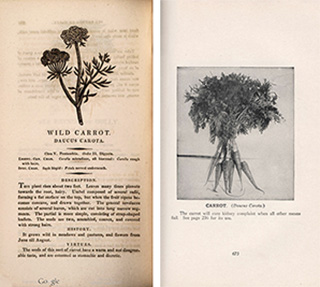
Daucus carota (Wild carrot)
(left) A New Family Herbal. London: R. Phillips, 1810.
Robert John Thornton (1768–1837), author.
Thomas Bewick (1753-1828), wood engraver.
(right) Vitalogy or Encyclopedia of Health and Home. Chicago: Vitalogy Association, 1904 (1925 printing).
George P. Wood and E. H. Ruddock (1822-1875), authors.
Note the difference in the size of these books. At the turn of the 20th century, huge encyclopedic volumes that addressed all aspects of health for the home became popular. Even as mass-produced, synthetic drugs were becoming more commonplace, these books often included sections on plant remedies. The smaller, older herbal is laid out in the traditional style, with a simple image, a scientific description, and instructions for medicinal use. The larger (nearly 1000 pages), newer book is focused on the image, directing the reader to another part of the book for the remedy. It makes use of the relatively recent technology of reproducing photography in books, which makes the book seem more cutting-edge and authoritative with its realistic depiction of the plant. The two books emphasize different parts of the carrot—the roots versus the flowers—but they each note similar uses: as a diuretic, which would help kidney complaints.
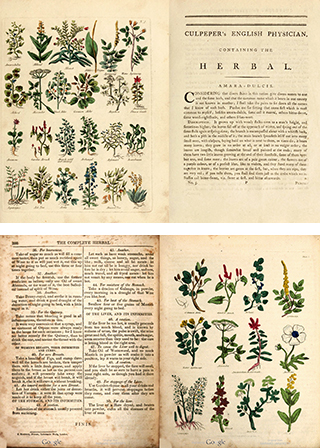
(top) Culpeper's English Physician, and Complete Herbal. London: Ebenezer Sibly, 1794.
(bottom) Culpeper's Complete Herbal. London: T. Kelly, 1819.
Nicholas Culpeper (1616-1654), author.
Ebenezer Sibly (1751-c. 1799), artist.
An herbal's layout is important to its ease of use, and also reflects the method used to print the illustrations. Gerard's Herball (top) and the New Family Herbal (directly above) each place the images with their related text, allowing the reader to view a plant as they read about it. This was easily done because the woodblocks on which the illustrations were carved were printed in the same way as the text, allowing them to be printed at the same time on the same printing press. The books above and below (later editions of Culpeper's 1652 English Physician) use engraved images, which are created in a different way than text and woodcut prints. They are printed on a different press—usually operated by a different printer—and then combined with the pages of text when the book is assembled. Grouping many illustrations on a single page meant fewer plates needed to be engraved and printed, but this would often separate the image from its accompanying text, sometimes by many pages. The 1819 edition below goes so far as to group all the illustrations at the back of the book, completely isolating them from the text.
Tropical Plants
Starting in the Age of Exploration (c. 1400-1650) and continuing for centuries, natural history books about foreign locations appealed to a broad European readership. They often featured images of unfamiliar and intriguing plants and animals that captivated people eager for details about far-away lands, while the informative text appealed to academic types who appreciated the emphasis on observations and empirical evidence.
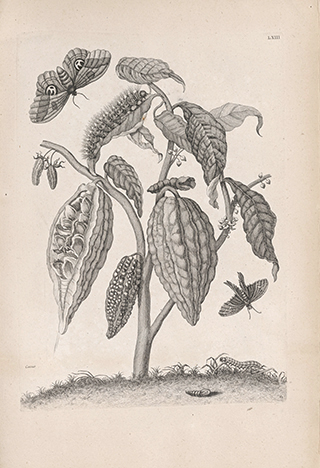
Theobroma cacao (Cacao)
Histoire générale des insectes de Surinam et de toute l'Europe (General history of the insects of Surinam and all of Europe), 3rd ed., vol. 1. Paris: L.C. Desnos, 1771.
Maria Sibylla Merian (1647-1717), creator.
Pierre-Joseph Buc'hoz (1731-1807), editor.
Jean Rousset (1686-1762), translator.
Jean Marret, translator.
Maria Sibylla Merian was an artist and naturalist who grew up painting and working in her family's print shop. She went on to produce her own illustrated books, and is unique because she and her daughters, Dorothea and Johanna, often completed all the illustrative work themselves, from the preliminary sketches, engraving the copperplates, and hand-coloring the final prints.
In 1699, Merian and Dorothea sailed to the Dutch colony of Suriname to study the region's insects. From a young age, Merian had reared silkworms and butterflies, and her desire to observe and draw Suriname's insects from life—instead of from dried specimens—led her to finance her own research trip.
While this is primarily an entomology book, Merian is considered one of the most talented botanical artists of her time. Her art was both scientifically and artistically significant, and it continues to inspire people working in both fields to this day.
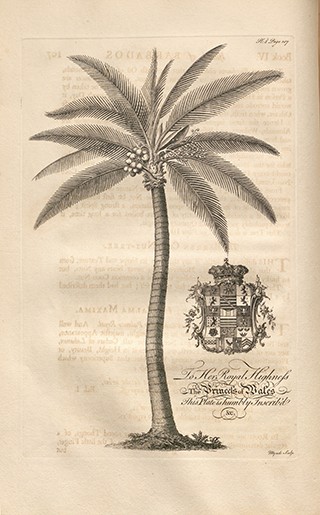
Palma nucifera (Coconut)
The History of Barbados. London: 1750.
Griffith Hughes (1706 or 7- ), author.
James Mynde (1702-1771), engraver.
Whereas Merian financed her South American trip and research herself, Griffith Hughes, a Welsh clergyman and naturalist, used a subscriber model to crowdsource funds for The History of Barbados. In this model, subscribers' names would be listed in the book they sponsored in acknowledgement of their financial support. Generous donors or VIPs could even sponsor an illustration. Their name and crest was then added to the image, as seen here with the dedication to the Princess of Wales (Princess Augusta of Saxe-Gotha, the mother of King George III).
Many of the people sponsoring books about the British Empire also funded expeditions to foreign locales or, more likely, profited from colonialist economies, such as the extraction of raw materials, the transatlantic slave trade, plantations, and especially the trade for new exotic goods, such as the coconuts depicted here.
Credits
Curated and designed by Emma Florio, MLIS, Archives & Research Specialist, and Katie Lattal, MA, Special Collections Librarian.
Bibliography
- "American Medical Botany, Jacob Bigelow." Historical Medical Library of The College of Physicians of Philadelphia. Accessed September 17, 2025. https://cppdigitallibrary.org/collections/show/43
- Blunt, Wilfrid. The art of botanical illustration: An illustrated history. Dover Publications, Inc.: New York, 1994.
- Bridson, Gavin D. R. and Donald E. Wendel. Printmaking in the service of botany: Catalog of an exhibition. Pittsburgh: Hunt Institute for Botanical Documentation, 1986. https://www.huntbotanical.org/publications/show.php?126
- Clement, John. “Griffith Hughes: S. P. G. Missionary to Pennsylvania and Famous 18th Century Naturalist.” Historical Magazine of the Protestant Episcopal Church 17, no. 2 (1948): 151–63. http://www.jstor.org/stable/42971982 .
- Ives, Colta. “Lithography in the Nineteenth Century.” Heilbrunn Timeline of Art History. The Metropolitan Museum of Art, New York. October 2004. http://www.metmuseum.org/toah/hd/lith/hd_lith.htm
- "John Gerard." Encyclopaedia Romana. University of Chicago. Accessed September 8, 2025. https://penelope.uchicago.edu/encyclopaedia_romana/aconite/gerard.html#anchor5371
- Lotzof, Kerry. “Maria Sibylla Merian: metamorphosis unmasked by art and science.” The Natural History Museum, London. Accessed September 10, 2025. https://www.nhm.ac.uk/discover/maria-sibylla-merian-metamorphosis-art-and-science.html
- “Maria Sibylla Merian: pioneering artist of flora and fauna.” Collection Stories. The British Museum. Accessed September 10, 2025. https://www.britishmuseum.org/collection/animals/maria-sibylla-merian-pioneering-artist-flora-and-fauna
- Marsh, David. “Hortus Eystettensis.” The Garden History Blog. November 17, 2018. https://thegardenhistory.blog/2018/11/17/hortus-eystettensis/