Reviving the Body

Science, Frankenstein, and the "Spark of Life"
Dates: Oct. 7, 2024 to April 29, 2025
Contact: ghsl-special
The 18th century was an age of experimentation in Europe. The scientific revolution of earlier centuries and the emphasis on reason and learning fostered by the Enlightenment allowed scientists to explore the workings of nature like never before. In this world of scientific inquiry, the study of electricity captured the imaginations of scholars and the public alike. Once scientists discovered how to create and store electrical charges, they harnessed the current in a wide range of experiments, from the practical and informative to the entertaining and bizarre. Of particular interest were its potential medical uses—How did it affect the body? Could it treat disease? Would it reanimate the dead?
This exhibit, and its companion Reconstructing the Body, were created in conjunction with the National Library of Medicine traveling exhibit, Frankenstein: Penetrating the Secrets of Nature, which explores the power of Mary Shelley's novel to expose hidden fears of science and technology as human efforts to penetrate the secrets of nature continue.
Events
Galter Library co-sponsored a panel discussion with the Master of Arts in Medical Humanities & Bioethics Program to examine the novel and its themes through a medical ethics lens.
What Can Stop the Determined Heart and Resolved Will of Man?: Innovation, Ethics, and Medicine in Frankenstein - Panel Presentation featuring Catherine Belling, PhD (Associate Professor, Medical Education), David Kendall Casey (Medical Student, MD/MA - Medical Humanities & Bioethics), and Megan Crowly-Matoka, PhD (Associate Professor, Medical Education; Anthropology).
Thursday, November 7, 2024 from 12:00 PM - 1:00 PM CT.
Electrifying Experiments
To understand electricity, scientists experimented with it in any way they could.
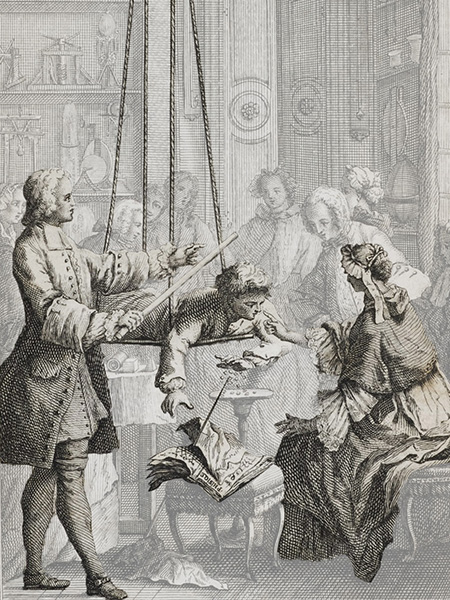
Here Jean Antoine Nollet reproduces Stephan Gray's “electric boy” experiment. An electrically charged boy hangs from insulating silk ropes and the scientist demonstrates how objects are statically drawn to his hands. A woman bends forward to poke the boy’s nose to get an electric shock. This memorable demonstration illustrates that the human body can conduct electricity. Frontispiece illustration. Nollet. Essai sur l'electricité des corps. Paris: Chez les freres Guerin, 1746.
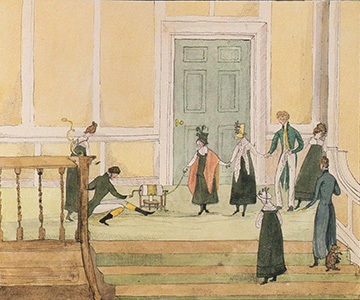
By the early 19th century, laypeople could acquire electrical apparatuses and perform experiments themselves, as in this painting where a family uses an electrifying machine to pass a current through their joined hands. Diana Sperling. May 25th. Henry Van electrifying -- Mrs. Van, Diana, Harry, Isabella, Mum, and HGS. Dynes Hall, ca. 1812-1823. Watercolor.
Galvanism
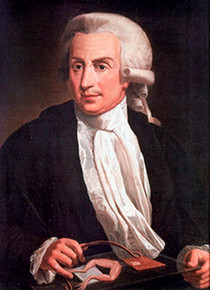 One notable scientist who experimented with electricity was Italian physician Luigi Galvani (1737–1798). Using dissected animal legs, he observed that muscles contracted and spasmed when stimulated by an electric current. Galvani believed this was due to an internal electricity inherent in animal tissue, which he called “animal electricity,” or galvanism. In his mind, this physical and metaphorical “spark” was a vital force that animated all living creatures. Although his theories were disproven, the “spark of life” theory proved intriguing to both scientists and artists, like Mary Shelley.
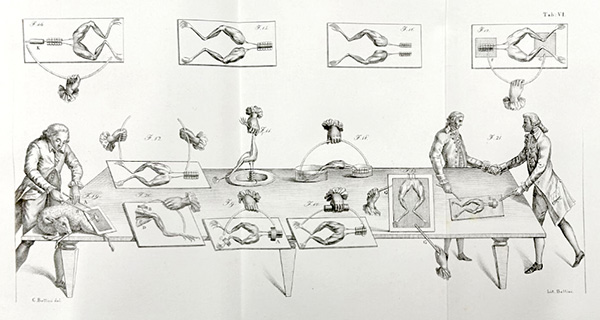
This print depicts Galvani’s famous experiments applying electric current to frogs’ legs in different variations, making them twitch. Also depicted are a lamb (Fig. 19) and a chicken leg (Fig. 20). Tabula VI. Galvani, Luigi. Opere edite ed inedite del professore Luigi Galvano. Bologna: E. dall’Olmo, 1841.
Masters of the Macabre
Scientists held public demonstrations of electricity as both experiments and entertainment. Galvani’s nephew, Giovanni Aldini (1762-1834), took his uncle’s animal experiments further: he performed public demonstrations using bodies of executed criminals, the only bodies legally available to science at the time. In 1803, he electrified the body of George Foster at Newgate Prison in London. For seven hours, in front of an amazed audience, he made the body move in ways he described as giving an “appearance of reanimation.”
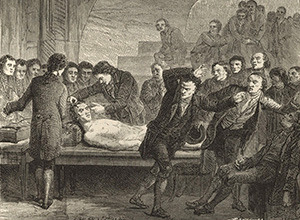 In 1818, anatomist James Jeffray, assisted by physician Andrew Ure, performed an experiment similar to Aldini’s with the body of Matthew Clydesdale at the University of Glasgow, seen at right. Aldini believed galvanism could be used for resuscitation, but Jeffray and Ure believed electrifying a corpse could potentially bring it back to life. "Le docteur Ure galvanisant le corps de l’assassin Clydsdale." In Louis Figuier. Les merveilles de la science. Paris: Furne, Jouvet et Cie, 1867.
Ure vividly described the results of his and Jeffray’s experiment in a journal article:
[When stimulating the supraorbital nerve in the forehead]... every muscle in his countenance was simultaneously thrown into fearful action; rage, horror, despair, anguish, and ghastly smiles, united their hideous expression in the murderer's face... At this period several of the spectators were forced to leave the apartment from terror or sickness, and one gentleman fainted.
Reviving the Apparently Dead
As experiments with electricity continued, interest in the physiology of death and possibilities of resuscitation grew. By the late 18th century, physicians had learned to distinguish between apparent death– when the patient only appeared dead and could be successfully resuscitated–and absolute death, which was irreversible.
Naturally, there was speculation that electricity could be used for resuscitation from apparent death. In 1809, Scottish surgeon Allan Burns first suggested a combination of electric shock and mouth-to-mouth ventilation, now commonly employed as cardiopulmonary resuscitation (CPR). Giovanni Aldini also advocated for electricity as the primary means of resuscitation.
It was in this scientific atmosphere an eighteen-year-old Mary Shelley (then Godwin) and her future husband Percy Shelley visited Lord Byron’s Alpine Villa in 1816. As entertainment, they competed to write ghost stories; Mary Shelley settled on the idea of a man-made creature, reanimated from death.
Galvanism and Frankenstein
Galvani’s idea of a “spark of life” influenced Mary Shelley’s Frankenstein. Shelley recalls her 1816 stay at Lord Byron’s villa in the preface to the 1831 edition of Frankenstein:
Many and long were the conversations between Lord Byron and Shelley, to which I was a devout but nearly silent listener. During one of these, various philosophical doctrines were discussed, and among others the nature of the principle of life, and whether there was any probability of its ever being discovered and communicated. …Perhaps a corpse would be re-animated; galvanism had given token of such things: perhaps the component parts of a creature might be manufactured, brought together, and endued with vital warmth.
Frankenstein, preface to the 1831 edition.
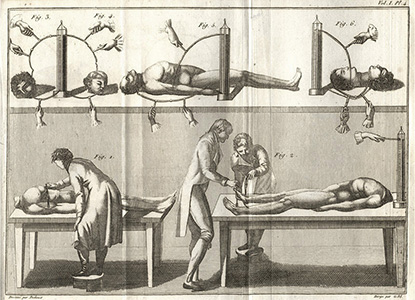
This print depicts Aldini’s experiments applying electric current to corpses. Plate 4, vol. 1. Aldini, Giovanni. Essai théorique et expérimental sur le galvanisme. Paris: Fournier fils, 1804.
Shelley invents Victor Frankenstein, a student of chemistry, whose studies lead him to discover how to reconstruct and reanimate a human being. His experiments with human remains and his own words echo the desires of James Jeffray and Andrew Ure:
...if I could bestow animation upon lifeless matter, I might in process of time (although I now found it impossible) renew life where death had apparently devoted the body to corruption.
Victor borrows the language of galvanism to describe bringing his creation to life:
I collected the instruments of life around me, that I might infuse a spark of being into the lifeless thing that lay at my feet. It was already one in the morning; the rain pattered dismally against the panes, and my candle was nearly burnt out, when, by the glimmer of the half-extinguished light, I saw the dull yellow eye of the creature open; it breathed hard, and a convulsive motion agitated its limbs.
Frankenstein, Volume 1, Chapter 4
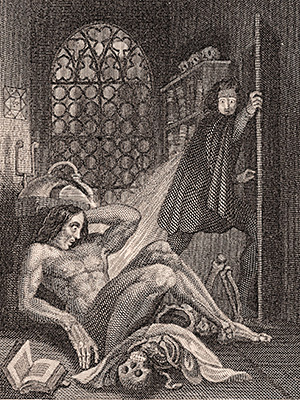 Shelley's word choice evokes galvanism here. In addition to the “spark of being,” the convulsions and agitations of the Creature recall the galvanic experiments that used electricity to cause muscle contractions in dead animals and humans, making them appear alive. Victor’s work by “half-extinguished” candlelight not only points to the secretive nature of his work, but further draws parallels between fire and electricity, as well as the boundary between life and death. Frontispiece. Shelley, Mary. Frankenstein. London: Colburn and Bentley, 1831.
From Science Fiction to Science Fact: The AED
 While Victor Frankenstein was a fictional scientist, experiments such as Galvani’s did inspire real progress in the medical field, such as in the development of resuscitation technology. Further experimentation in the 19th and 20th centuries led to the development of the automatic external defibrillator (AED), a device that uses an electric current to reestablish a normal heart rhythm in patients experiencing life-threatening fibrillation (irregular contraction of the cardiac muscles) and tachycardia (abnormally fast heart rate). Within 30 years, AED devices became a vital part of emergency medicine.
Timeline of the AED
1899 - Italian physiologists demonstrate that electric currents can both stop and restart the heart
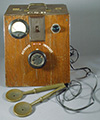
1947 - American cardiac surgeon Claude Beck performs the first successful internal defibrillation on a human, by putting paddles (above) directly on a patient’s heart
1950s - American cardiologist Paul Zoll and engineer William Kouwenhoven develop external defibrillators that use alternating current; they are heavy and the voltage can damage the heart
1962 - American cardiologist Bernard Lown helps develop a defibrillator that uses direct current, which is safer and easier to use
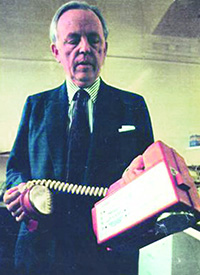
1968 - Northern Irish cardiologist Frank Pantridge (above) develops the first portable defibrillator, weighing 7 pounds
1978 - First “fool proof” portable AED that can be used by laypeople is developed
1980 - First implantable cardioverterdefibrillator (ICD) is surgically placed in a patient

2001 - FDA approves a wearable cardioverterdefibrillator vest (above)
Credits
Curated and designed by Emma Florio, MLIS, Katie Lattal, MA, Lindsey O'Brien, MSLIS; and Annie Wescott, MLIS.
Bibliography
Primary Resources
- Aldini, Giovanni. Essai théorique Et Expérimental Sur Le Galvanisme: Avec Une Série D'expériences Faites En Présence Des Commissaires De L'institut National De France, Et En Divers AmphithéAares Anatomiques De Londres. Paris: Fournier fils, 1804.
- Aldini, John. An Account of the Late Improvements in Galvanism. London: Cuthell and Martin, J. Murray, 1803.
- ———. General Views on the Application of Galvanism to Medical Purposes; Principally in Cases of Suspended Animation. London: Sold by J. Callow [and 2 others], 1819.
- Figuier, Louis. "Le Docteur Ure Galvanisant Le Corps De L'assassin Clydsdale [Illustration]." In Les Merveilles De La Science. Paris: Furne, Jouvet et Cie, 1867.
- Galvani, Luigi, Silvestro Gherardi, Giuseppe Venturoli, and Bassiano Carminati. Opere Edite Ed Inedite Del Professore Luigi Galvano Raccolte E Pubblicate Per Cura Dell'accademia Delle Scienze Dell'istituto Di Bologna. Bologna: Tip. di E. dall'Olmo, 1841.
- Nollet, Jean-Antoine. "[The Electric Boy] [Frontispiece]." In Essai Sur L'electricité Des Corps. Paris: Chez les freres Guerin, 1746.
- Shelley, Mary Wollstonecraft. Frankenstein: Or, the Modern Prometheus. Rev., corr., & illus. ed. London: Colburn and Bentley, 1831.
- Sperling, Diana. "May 25th. Henry Van Electrifying -- Mrs. Van, Diana, Harry, Isabella, Mum, and Hgs. Dynes Hall [Watercolor]." ca. 1812-1823.
- Ure, Andrew. "An Account of Some Experiments Made on the Body of a Criminal Immediately after Execution, with Physiological and Practical Observations." Journal of Science and the Arts 6 (1819): 283-94.
![May 25th. Henry Van Electrifying -- Mrs. Van, Diana, Harry, Isabella, Mum, and Hgs. Dynes Hall [Watercolor]](https://commons.wikimedia.org/wiki/File:May_25th._Henry_Van_electrifying_--_Mrs._Van,_Diana,_Harry,_Isabella,_Mum,_and_HGS._Dynes_Hall.jpg%20)
Secondary Resources
- Adee, Sally. "Spectacular Pseudoscience: The Fall and Rise of Bioelectricity." In We Are Electric: Inside the 200-Year Hunt for Our Body’s Bioelectric Code and What the Future Holds. New York: Hachette, February 28, 2023.
- AlGhatrif, Majd, and Joseph Lindsay. "A Brief Review: History to Understand Fundamentals of Electrocardiography." [In eng]. J Community Hosp Intern Med Perspect 2, no. 1 (2012).
- Alzaga, Ana Graciela, Joseph Varon, and Peter Baskett. "Charles Kite: The Clinical Epidemiology of Sudden Cardiac Death and the Origin of the Early Defibrillator." Resuscitation 64, no. 1 (2005): 7-12.
- Ball, Christine M., and Peter J. Featherstone. "Early History of Defibrillation." [In eng]. Anaesth Intensive Care 47, no. 2 (Mar 2019): 112-15
- Bennett, Rachel E. "A Fate Worse Than Death? Dissection and the Criminal Corpse." In Capital Punishment and the Criminal Corpse in Scotland, 1740–1834 London: Palgrave Macmillan, 2017.
- Bertucci, P. "Sparks in the Dark: The Attraction of Electricity in the Eighteenth Century." [In eng]. Endeavour 31, no. 3 (Sep 2007): 88-93.
- Bresadola, Marco. "Medicine and Science in the Life of Luigi Galvani (1737–1798)." Brain Research Bulletin 46, no. 5 (1998/07/15): 367-80.
- Davidson, Luke A. F. "Raising up Humanity: A Cultural History of Resuscitation and the Royal Humane Society of London, 1774-1808." Doctor of Philosophy, University of York, 2001.
- Garde, Ruth. "Charged Bodies: Experiments with Electricity and the Human Body in the 18th Century." Brewminate, 2017.
- MacDonald, Helen. "Galvanising George Foster, 1803 [Edited Excerpt]." In Human Remains. Yale University Press: London, 2006.
- Montandon, Denys. "Frankenstein, the Aesthetic Failure." [In eng]. J Craniofac Surg 31, no. 7 (Oct 2020): 1857-60.
- "The Italian ‘Mad Scientist’ Whose Experiments Inspired Frankenstein." Italian Sons and Daughters of America (ISDA), October 31, 2019.
- Naser, Nabil. "On Occasion of Seventy-Five Years of Cardiac Defibrillation in Humans." [In eng]. Acta Inform Med 31, no. 1 (Mar 2023): 68-72.
- Parent, André. "Giovanni Aldini: From Animal Electricity to Human Brain Stimulation." [In eng]. Can J Neurol Sci 31, no. 4 (Nov 2004): 576-84.
- "The Real Electric Frankenstein Experiments of the 1800s." Atlas Obscura, October 31, 2016, accessed August, 2024.
- Rogers, Kara. "Defibrillation." In Encyclopedia Britannica, 2009; last updated July 18, 2024.
- Ruston, Sharon. Shelley and Vitality. Houndmills [England]: Palgrave Macmillan in association with Arts and Humanities Research Board, 2005.
- ———. "The Science of Life and Death in Mary Shelley’s Frankenstein." Public Domain Review, November 25, 2015.